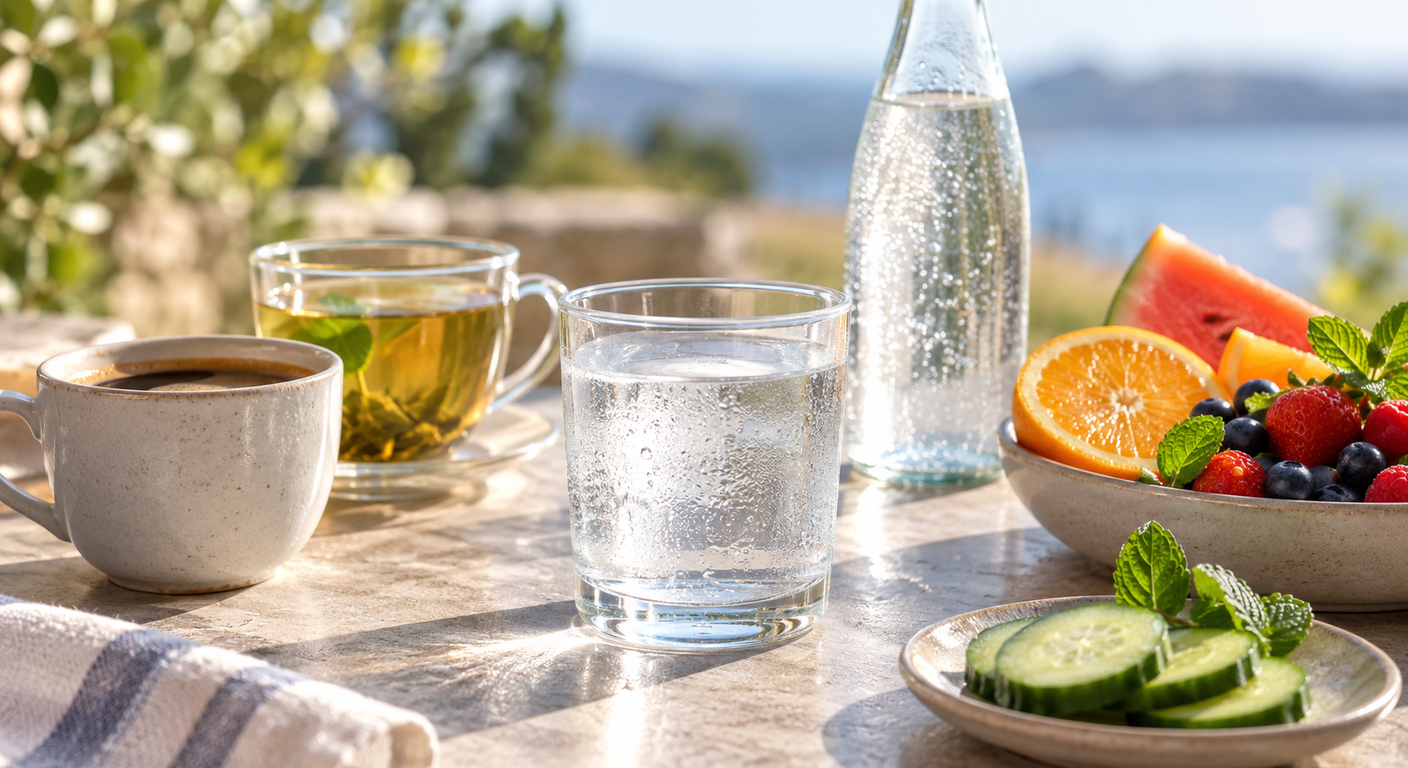
Plain water is not the only thing that contributes to hydration. Tea, coffee, milk, sugar-free drinks, and water contained in food can all contribute to your daily fluid intake.
That does not make every drink nutritionally equivalent. A drink can provide fluid while also containing caffeine, sugar, calories, sodium, or other ingredients worth considering. The useful question is therefore not simply “Does this count?” but “How does this drink fit into the rest of my day?”
Here is a practical way to think about the most common drinks without turning hydration into an accounting exercise.
Total water is more than plain drinking water
Hydration recommendations often refer to total water intake. That total can come from three places:
- plain water;
- other drinks;
- moisture naturally present in food.
The European Food Safety Authority sets adequate total water intakes of 2.0 litres per day for adult women and 2.5 litres for adult men under moderate conditions. Those figures include water from all beverages and food. They are population reference values, not instructions to drink that exact amount from a bottle.
The UK National Health Service uses a simpler public-health guide of 6 to 8 cups or glasses of fluid per day, while noting that needs can increase with heat, prolonged activity, pregnancy, breastfeeding, and illness.
Both approaches point to the same idea: a “daily water target” is a practical guide, not a measurement of plain water in isolation.
Does coffee count toward water intake?
Yes. For most adults, a normal cup of coffee contributes fluid.
Caffeine can have a diuretic effect, meaning it may increase urine production. But that does not mean every caffeinated drink removes more water than it provides. The NHS explicitly includes tea and coffee among the drinks that can count toward daily fluid intake.
One controlled crossover study compared coffee with water in 50 men who habitually drank coffee. During the coffee trial, participants drank four 200 ml servings containing a total caffeine dose of 4 mg per kilogram of body weight each day. Researchers found no significant difference between the coffee and water trials across several hydration measures.
That result is useful, but it should not be stretched too far. The study lasted three days, included habitual coffee-drinking men, and did not test every dose, every person, or every circumstance. It supports a modest conclusion: moderate coffee intake does not automatically cause dehydration in people accustomed to drinking it.
Coffee may still be a poor choice for you late in the day or in large amounts. Caffeine sensitivity varies, and too much can contribute to insomnia, jitters, anxiety, nausea, headache, or a rapid heartbeat. The US Food and Drug Administration cites 400 mg per day as an amount not generally associated with negative effects for most adults, but it also stresses that individual sensitivity and medical circumstances differ.
If you are pregnant, the NHS advises limiting caffeine to 200 mg per day. If a health condition or medication affects how you respond to caffeine, ask a healthcare professional what limit is appropriate for you.
Does tea count?
Yes. Black tea, green tea, herbal tea, and decaffeinated tea all provide fluid.
Black and green tea usually contain caffeine, while most herbal infusions do not. The amount varies with the type of tea, serving size, brewing time, and product. As with coffee, the presence of caffeine does not erase the water in a typical cup.
What you add can change the nutritional picture. Unsweetened tea and a heavily sweetened bottled tea both provide fluid, but they are not equivalent sources of sugar or calories. Hydration is only one property of a drink.
What about sparkling water?
Plain sparkling water can contribute to daily fluid intake. The NHS suggests sparkling water as an option for people who do not like still water, and the CDC lists sparkling water and seltzer among low- or no-calorie drink choices. NHS CDC
The label still matters. Some flavoured products contain added sugar, sweeteners, sodium, caffeine, or acids. That does not automatically make them unsuitable, but it means “sparkling water” can describe products with very different ingredients.
If carbonation makes it easier for you to drink regularly, plain or unsweetened sparkling water can be a useful alternative to still water.
Do milk and plant-based drinks count?
Milk contributes fluid, and the NHS includes lower-fat milk among everyday hydrating drinks. Unsweetened plant-based drinks also contain a large amount of water, although their protein, sugar, fat, vitamin, and mineral content can differ substantially from dairy milk and from one another.
Again, “counts as fluid” is not the same as “can be consumed without regard to the rest of your diet.” A glass of milk can contribute hydration and nutrition, but it is not interchangeable with plain water in every situation.
Do juice, soft drinks, and sports drinks count?
They contain water, so they contribute fluid. That alone does not make them the best default drinks.
Fruit juice and smoothies can be high in free sugars. The NHS recommends limiting their combined intake to one small 150 ml glass per day and having it with a meal. Sugary soft drinks can add a substantial amount of sugar and calories without being more hydrating than simpler choices.
Sports drinks are designed for a particular context. They may be useful during long periods of heavy sweating, when carbohydrate and electrolyte replacement is relevant. They are usually unnecessary for a normal desk day, a short walk, or a brief light workout.
For more detail on matching fluids and electrolytes to heat and activity, read How Much Water Should You Drink in Hot Weather?
Does food count toward hydration?
Yes. Fruit, vegetables, yoghurt, soups, stews, and many other foods contain water. Even foods that do not look watery contribute some moisture.
You do not need to estimate the water content of every meal. The important point is that official total-water figures already recognise water from food. Treating a 2.0- or 2.5-litre total-water reference as a compulsory bottle target can therefore lead to double counting.
Food intake also changes from day to day. A meal built around soup, fruit, and vegetables provides more water than a dry snack. This is one reason a precise universal plain-water target is difficult to justify.
What should you count in a hydration tracker?
There is no need to turn every cup of tea or bowl of soup into a laboratory calculation. Choose a method that gives you useful information and that you can repeat consistently.
Three approaches can work:
Track plain water only
This is the simplest option. Your tracker shows whether you are keeping a regular water routine, while other drinks and food remain part of the wider context.
The number will not represent total water intake, but it can show long gaps in the water entries you recorded.
Track the drinks you deliberately use for hydration
You might count water, unsweetened tea, and similar everyday drinks while leaving out occasional beverages. This produces a broader estimate without requiring you to record everything.
If you want to compare your own logs over time, using the same definition each day makes those records easier to interpret.
Track all drinks
This gives the fullest beverage total, but it also creates more work and still does not measure water from food, sweat loss, or individual medical needs.
More detailed logging is not automatically more informative if the extra entries are not relevant to what you are trying to observe.
Whichever method you choose, do not subtract a cup of coffee as if it created a hydration debt. Record what is useful, keep the definition consistent, and treat the result as an estimate rather than a clinical measurement.
A simple rule for everyday use
For most healthy adults, this is enough:
- Let plain water be your easiest default drink.
- Remember that tea, coffee, milk, and other drinks still contribute fluid.
- Consider caffeine, sugar, calories, and other ingredients separately.
- Increase access to fluids when heat, activity, or illness changes your day.
- Follow individual medical advice if you have been told to restrict fluids or monitor them closely.
If remembering is the difficult part, focus on the routine rather than perfect accounting. These eight practical hydration habits can help make the next drink easier to notice and repeat.
Octi Flow is designed for that everyday pattern: quick logging, gentle reminders, and visible progress without requiring you to calculate every source of water in your diet.
Sources and further reading
-
European Food Safety Authority: Scientific Opinion on Dietary Reference Values for Water
-
US Food and Drug Administration: Spilling the Beans: How Much Caffeine Is Too Much?
-
Killer et al.: No Evidence of Dehydration With Moderate Daily Coffee Intake
This article provides general information and is not a substitute for individual medical advice. Follow guidance from a healthcare professional if you have a condition or take medication that affects fluid balance, or if you have been advised to restrict fluids.