Search for how much water you should drink a day and you will quickly run into a strange problem: reputable sources give different answers.
The European Food Safety Authority, or EFSA, gives adequate daily total water intake values of about 2.0 litres for adult women and 2.5 litres for adult men. In the United States, the National Academies uses higher figures, about 2.7 litres for women and 3.7 litres for men. The NHS gives a much simpler everyday guide of 6 to 8 cups or glasses of fluid a day. EFSA, National Academies, and the NHS all frame these numbers as guidance, not as an exact prescription for every person.
So which number is right? More than one can be useful, because they are not all describing exactly the same thing. The most important distinction is that your total water intake is not the same thing as the amount of plain water you need to pour into a glass.
The quick answer
There is no single daily amount of water that is correct for every healthy adult.
For a useful starting point, these are three widely used recommendations:
| Guidance | Women | Men | What it refers to |
|---|---|---|---|
| EFSA | 2.0 L/day | 2.5 L/day | Total water from drinks and food |
| US National Academies | 2.7 L/day | 3.7 L/day | Total water from drinks and food |
| NHS | 6 to 8 cups or glasses/day | 6 to 8 cups or glasses/day | Practical guide to fluids |
EFSA’s adult values include water from drinks and food. The National Academies also defines its figures as total water from drinking water, other beverages and food. The NHS uses a simpler public health message focused on fluids rather than total water from all sources. EFSA, National Academies, NHS
That is why seeing “3.7 litres a day” does not mean every man should drink 3.7 litres of plain water from a bottle.
And none of these figures is a personalised prescription.
The National Academies notes that water requirements vary widely because of activity, environment and individual circumstances, which is why one exact requirement cannot fit every healthy person. National Academies
Why do official recommendations differ?
At first glance, 2.5 litres and 3.7 litres look too far apart to both make sense.
But dietary reference values are not measurements of the exact amount your body must receive every 24 hours. They are population-level guidance developed using different evidence, definitions and methods.
EFSA’s adult values are 2.0 litres of total water for women and 2.5 litres for men under moderate conditions. The US National Academies established Adequate Intakes of 2.7 and 3.7 litres of total water for women and men. Both include water from food as well as beverages. EFSA, National Academies
The useful way to read these figures is as reference points, not as pass-or-fail thresholds.
How much plain water should you actually drink?
There is no official number that can be cleanly separated from the rest of your diet and applied to everyone.
You get water from three broad sources:
- plain drinking water;
- other beverages;
- food.
The National Academies reports that in US survey data, roughly 80 percent of total water intake came from drinking water and other beverages, with the remainder coming from food. Mayo Clinic gives the same useful rule of thumb, noting that food typically provides about 20 percent of daily fluid intake. National Academies, Mayo Clinic
That does not mean you need to calculate the water content of dinner.
Someone who eats plenty of fruit, vegetables, yoghurt and soups may get more water from food than someone eating mostly dry foods.
Tea, coffee, milk and other drinks can contribute too. If you want to know what makes sense to count in a hydration tracker, we cover that separately in What Counts Toward Your Daily Water Intake?
For most people, plain water is still the simplest everyday choice. It hydrates without added sugar or calories, which is why health authorities commonly recommend it as a default drink. But it does not have to be your only source of fluid. NHS
What about the eight glasses a day rule?
Eight glasses is easy to remember, which is probably its biggest strength. It is not a universal biological requirement.
The NHS currently recommends aiming for around 6 to 8 cups or glasses of fluid a day as a general guide. Mayo Clinic describes eight glasses as a reasonable and memorable goal for some people while also stressing that fluid needs vary. NHS, Mayo Clinic
There is no need to treat the eighth glass as a finish line.
If you are comfortably hydrated with somewhat less on a quiet, cool day, that does not automatically mean something is wrong. If you spend hours exercising outside in hot weather, eight glasses may be nowhere near enough. Context matters more than the slogan.
Should men and women drink different amounts?
Population guidelines often give different reference values for men and women.
EFSA uses 2.5 litres of total water for adult men and 2.0 litres for adult women. The National Academies uses 3.7 and 2.7 litres respectively. EFSA, National Academies
That does not mean every man needs more water than every woman.
These are reference values for groups, not a measurement taken from your individual body.
A physically active woman working outside in summer may need more fluid than a sedentary man spending the day in an air-conditioned office.
This is one reason a water tracker should not present sex alone as if it can calculate an exact physiological requirement.
How much water should you drink based on your weight?
Weight-based water calculators are everywhere online. You enter your body weight, multiply it by a number, and receive an apparently precise answer such as 2,415 ml per day.
The precision looks scientific. The problem is that body weight does not tell the whole story.
Major adult guidance from EFSA, the National Academies and the NHS does not use one universal weight-only formula for daily water needs. The National Academies specifically notes that water requirements vary with physical activity and environmental conditions, while Mayo Clinic also lists exercise, environment, health, pregnancy and breastfeeding among factors that can change fluid needs. National Academies, Mayo Clinic
Body size can matter. It is simply not the only variable.
Consider two people who weigh exactly 75 kg.
One spends the day at a desk in mild weather.
The other cycles for two hours in summer heat.
A calculator using only weight would give them the same answer even though their fluid losses that day may be very different.
So a weight-based estimate can be a rough starting point, but it should not be mistaken for an exact personal requirement.
What changes how much water you need?
Your water needs are not necessarily identical from Monday to Tuesday.
The NHS advises that people may need more fluid when they are pregnant or breastfeeding, in a hot environment, physically active for long periods, ill or recovering from illness. Mayo Clinic likewise identifies exercise, environment and health as important reasons intake may change. NHS, Mayo Clinic
| Situation | Why your normal target may not fit |
|---|---|
| Hot or humid weather | More water may be lost through sweating |
| Exercise | Sweat losses rise with duration and intensity |
| Fever | Illness can increase fluid losses |
| Vomiting or diarrhoea | Water and electrolytes can be lost |
| Pregnancy | Fluid needs increase |
| Breastfeeding | Additional fluid is needed to support milk production |
| Some medical conditions or medicines | Fluid requirements may need individual medical guidance |
For hot weather, see How Much Water Should You Drink in Hot Weather?
For vomiting, diarrhoea and oral rehydration solution, see How to Stay Hydrated When You’re Sick
Pregnancy is another situation where general adult figures are not enough. The American College of Obstetricians and Gynecologists advises drinking 8 to 12 cups of water per day during pregnancy. ACOG
How can you tell if you are drinking enough?
A calculator is not your only source of information.
For most healthy adults, thirst is useful. The National Academies notes that normal thirst and drinking behaviour are important parts of maintaining water balance. Mayo Clinic says you may be drinking enough if you do not often feel thirsty and your urine is colourless or light yellow. National Academies, Mayo Clinic
The NHS also suggests aiming for urine that is a clear, pale yellow colour. NHS
None of these signs gives you an exact litre requirement. They are clues, not precise measurements.
If you are regularly very thirsty, producing dark urine, urinating much less than usual or feeling dizzy, dehydration may be part of the picture. Persistent or unusual symptoms deserve more attention than simply increasing a number in an app. NHS
Do you need to drink before you feel thirsty?
For ordinary daily life, you do not need to spend the day trying to stay permanently ahead of thirst.
That does not mean you should ignore thirst either.
A practical routine often combines normal thirst with easy access to drinks and a few natural opportunities to drink during the day.
If work, meetings or travel make you forget for long periods, reminders can be useful. But the reminder is solving a memory problem, not proving that your body requires water at that exact minute.
We cover this in more detail in How Often Should You Drink Water? and How to Remember to Drink Water
Can you drink too much water?
Yes, although it is uncommon in healthy adults during normal daily life. Drinking excessive amounts of water can become dangerous.
If water intake overwhelms the body’s ability to remove the excess, sodium in the blood can become too diluted. This condition is called hyponatremia and can be life-threatening. Mayo Clinic notes that excessive water intake is one possible cause, with particular concern in situations such as endurance exercise. Mayo Clinic
This is another reason daily hydration should not become a competition: more is not automatically better.
An app target is a record of a drinking pattern, not an instruction to consume a large remaining volume rapidly at the end of the day. If late drinking is contributing to repeated nighttime urination, timing can matter; our guide to drinking water before bed explains the evidence and its limits.
A daily goal should be treated as a behavioural tracking tool, not a medical prescription.
So what target should you put in a water-tracking app?
This is where a useful hydration target differs from a supposedly perfect hydration formula.
Start with a reasonable reference value and decide what you are actually going to track.
If your target represents all fluids, it should not be interpreted the same way as a target that represents plain water only.
If you log tea, coffee and milk, those drinks are already contributing to the number. If you log only plain water, part of your total water intake is happening outside the tracker.
If you use Octi Flow, it makes more sense to treat the daily goal as a practical target for building and observing your drinking routine, not as a medical measurement of the water inside your body.
A useful target should help answer “Am I drinking consistently enough for my normal routine?” It should not pretend to answer “What is my exact physiological water requirement today?”
No consumer hydration app can know that from a profile form alone.
A practical way to choose your starting target
Rather than searching endlessly for one perfect number, use official guidance as context and then look at your real routine.
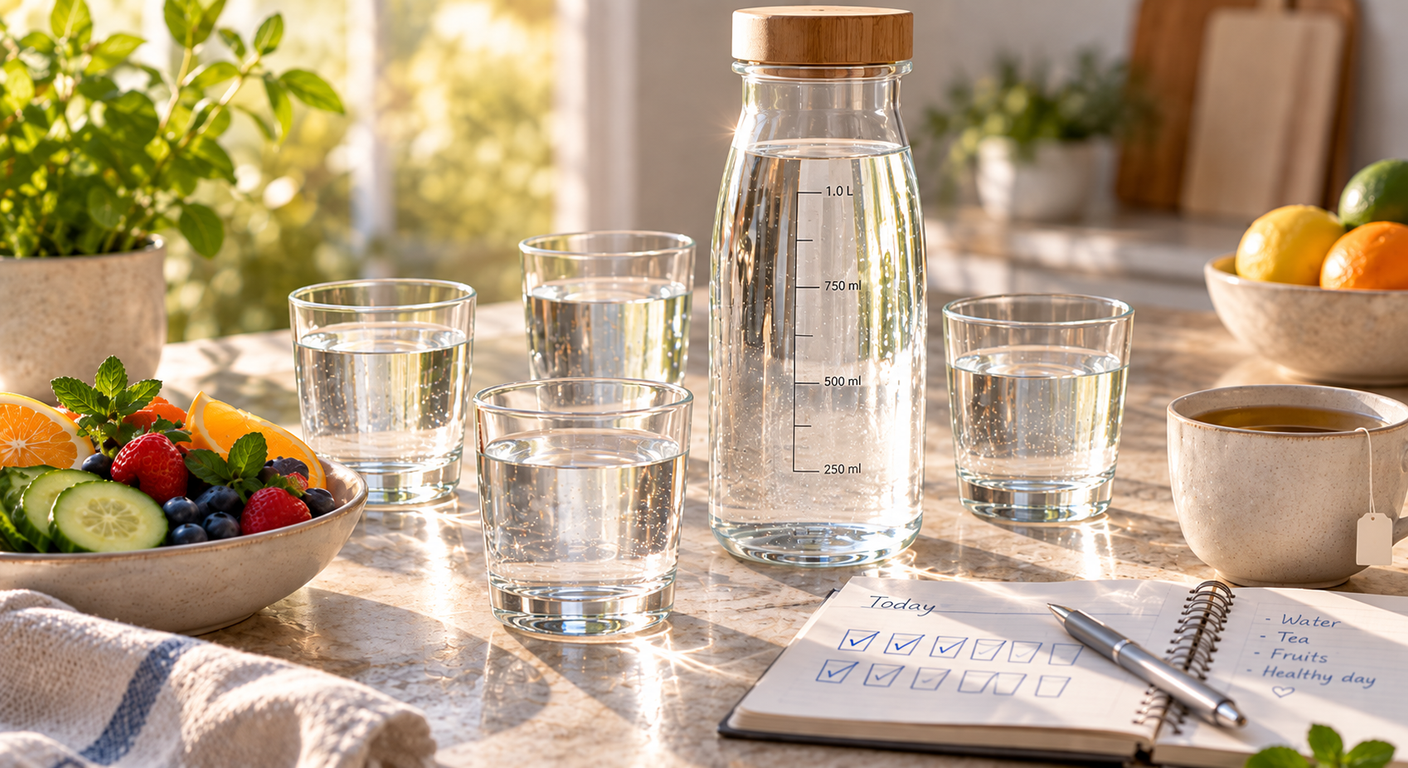
- Decide whether you want to track plain water or a broader range of drinks.
- Pick a sensible starting target rather than an aggressively high one.
- Use it for several normal days.
- Notice when you naturally drink and when you forget.
- Adjust your routine when heat, exercise or illness changes the situation.
- Do not treat the number as a medical prescription.
If you are repeatedly drinking solely to complete the number despite not being thirsty, reconsider what the target represents.
If you routinely finish the day very thirsty despite hitting the target, the logged number alone is not enough to explain your hydration status or fluid needs.
And if you have been given specific fluid instructions because of kidney disease, heart disease or another medical condition, those instructions take priority over any general recommendation or app target.
This is also how we think about Octi Flow on the App Store. The useful part of tracking is not making 2,000 ml look more medically precise than 1,950 ml. It is making a daily habit visible enough that you can understand and improve it.
The number matters less than knowing what the number means
If there is one idea worth remembering from all the competing water recommendations, it is this:
2 litres of total water is not necessarily 2 litres of plain drinking water.
Neither is 2.7 litres. Neither is 3.7 litres.
Food contributes water. Other drinks contribute water. Your needs change with heat, activity, health and other circumstances.
The figures from EFSA, the National Academies and the NHS are useful because they give us reference points. They become less useful when we turn them into rigid personal quotas.
So if you came here looking for one exact answer to “How much water should I drink a day?”, the best evidence-based answer is more practical:
Use a reasonable guideline as your starting point, count the fluids you actually consume, pay attention to thirst and your usual hydration pattern, and adjust when your circumstances change.
That is less satisfying than a magic formula.
It is also much closer to how hydration really works.
Sources and further reading
- European Food Safety Authority: Scientific Opinion on Dietary Reference Values for water
- National Academies: Dietary Reference Intakes for Water, Potassium, Sodium, Chloride, and Sulfate
- NHS: Water, drinks and hydration
- NHS: Dehydration
- Mayo Clinic: Water, how much should you drink every day?
- Mayo Clinic: Hyponatremia, symptoms and causes
- American College of Obstetricians and Gynecologists: How much water should I drink during pregnancy?
This article provides general information for healthy adults. It is not a substitute for individual medical advice. If you have a condition that affects fluid balance, take medicines that affect urination or sodium levels, or have been advised to restrict fluids, follow the advice of your healthcare professional.